

In 2025, the Swedish fintech sector experienced vibrant entrepreneurial activity, rapid expansion, and heightened regulatory scrutiny.
The sector benefited from a strong startup ecosystem that has produced over 1,000 fintech firms nationwide, including notable players such as Tink, Klarna, and Zettle, according to data from Dealroom. This figure positions Sweden as the Nordic region’s leader in fintech, accounting for 42% of the 2,400+ fintech startups across the region.
Regulatory developments were another significant catalyst for change. In December 2024, the EU’s Markets in Crypto-Assets Regulation (MiCA) took effect, and the Swedish Financial Supervisory Authority (SFSA) promptly issued its first Crypto Asset Service Provider (CASP) license to Safello in October 2025, covering crypto-asset trading, custody, and transfer activities.
The European Digital Operational Resilience Act (DORA) began applying in January 2025, imposing rigorous requirements for the security of network and information systems of companies and organizations operating in the financial sector, as well as critical third parties which provide information communication technologies (ICT)-related services to them.
In January 2026, Sweden implemented the EU’s Network and Information Security Directive (NIS2) through national legislation, imposing a comprehensive set of cybersecurity obligations on both public and private organizations operating in critical and important sectors, including banking, financial market infrastructure, and digital infrastructure.
Within this burgeoning ecosystem, a number of fintech startups are standing out for their strong growth, innovation, and international expansion. Over the past year, these ventures have secured investments from prominent investors, entered new markets, and gained increasing global visibility, milestones which are positionning them for continued momentum in 2026.
6 Fintech Startups from Sweden to Follow
Quartr

Founded in 2020 and based in Stockholm, Quartr is a technology company that enables leading companies and financial institutions worldwide to make informed decisions quickly. The company offers a suite of products designed for accessing and analyzing qualitative information from public companies:
- The Quartr mobile app offers a free and intuitive way to always stay informed, access earnings calls with a podcast-like experience, and conduct research anytime, anywhere;
- Quartr Pro is a desktop research platform that enhances efficiency and precision in qualitative public market research for top hedge funds, asset managers, equity research departments, and investor relations (IR) professionals; and
- The Quartr API enables third parties to build custom solutions powered by the company’s unique live earnings calls and transcription technology and its extensive global database of IR material, including public company filings, archived earnings call transcripts, and slide deck presentations.
Quartr raised US$10 million in a funding round in July 2025 to support its global expansion, including new offices in New York and Dublin to meet accelerating demand, and further product development as institutional demand for structured qualitative data increases. It reported a growth of 300% year-over-year (YoY) of its annual recurring revenue (ARR) by the end of Q1 2025, after signing prominent clients such as Perplexity, Yahoo Finance, and Fortune for its API, and four out of five of the world’s largest hedge funds for Quartr Pro.
With strong momentum and growing partnerships, Quartr is positioned for continued momentum in 2026.
Mynt

Founded in 2018 and headquartered in Stockholm, Mynt provides corporate cards and an artificial intelligence (AI)‑driven platform for expense management. Through automation and seamless integrations with leading accounting systems, Mynt helps companies streamline their entire expense management workflow, from receipt capture and expense entry to per‑diem and mileage allowances, freeing up time for growth. It claims that this automation reduces the time required to process a single expense report from the traditional 20‑45 minutes to roughly 30‑120 seconds, representing a 95% decrease in administrative effort and saving an average small and medium-sized enterprise (SME) team 10‑20 hours each month.
As of 2025, Mynt served more than 20,000 corporate customers across Sweden, Norway, and Finland, and had begun expanding into Denmark. This growth had been reinforced by strategic partnerships.
In April, it announced a strategic investment from Visa as part of its Series B round. That partnership gave Mynt access to a broader network of issuers and allowed it to deliver its technology to a large pool of financial institutions.
In July, Mynt entered into a partnership with Nordea, the largest bank in the Nordics, to launch a joint business credit card and spend management solution for SMEs throughout the region. This solution, slated to go live in 2026, will embed Mynt’s white labelled infrastructure within Nordea’s pan‑Nordic platform, delivering an all‑in‑one card and expense‑management product with automated receipt handling, real‑time spend controls, ERP integrations, and full accounting automation.
Mynt’s rapid expansion across the Nordics, and strategic backing industry leaders position it as a fast growing fintech innovator poised to reshape corporate spending in 2026.
Grasp
Founded in 2020, Grasp automates complex finance work through multi-agent AI systems, serving investment banks, management consultants, private equity firms, and corporate strategy teams across 30 countries.
The company’s flagship product, the AI Analyst, is purpose‑built for advisory and investing workflows, streamlining tasks such as target and buyer identification, company valuation, market research, and PowerPoint creation. This results in faster execution and higher-quality output.
In October 2025, Grasp reported a 3.5‑fold increase in annual recurring revenue (ARR) over the previous twelve months and served nearly 200 customers, including most of the Big Four consulting firms and leading global investment banks. By the end of 2025, the company had added more than 150 new customers, quadrupling ARR and prompting the launch of a London office on Cannon Street.
Grasp’s rapid growth, and expanding client base make it a significant player worth watching in 2026.
Northmill Bank

Based in Stockholm and founded in 2006, Northmill Bank is a technology‑driven Swedish challenger bank delivering financial services to private customers and businesses. The bank emphasizes a customer‑centric approach, positioning itself as a trusted partner that builds genuine connections through thoughtful experiences and continuous innovation.
For consumers, Northmill Bank offers flexible credit options, savings accounts, payment cards, and consolidation loans, all designed to give users control, transparency, and flexibility. For businesses, it provides small‑business credit lines, larger financing for major investments, versatile transaction accounts, and point‑of‑sale (POS) hardware, supported by certifications for Swish and RIX‑INST that ensure fast, reliable payments.
Northmill Bank reported strong market performance in 2025. Earnings before tax rose 56 % YoY to SEK 224 million (US$25 million) in 2025, while operating income grew 18 % to SEK 881 million (US$99 million), driven by higher net interest and transaction‑related income.
Growth was particularly pronounced in the business-to-business (B2B) segment, with the lending portfolio expanding 4.5-fold YoY to roughly SEK 1 billion (US$112 million) in disbursed volume, and the number of B2B clients reaching 4,700 by the end of the year.
On the consumer side, the business-to-consumer (B2C) gross portfolio grew 13% in 2025, outpacing the market’s 4% growth. The number of card customers surged to 211,000, marking a 3.5‑fold increase over 2024. In 2025, the bank expanded its B2C offering with the launch of a flexible and innovative mortgage product for the Swedish market.
To promote continued strong growth and further enhance the platform, Northmill Bank made intentional investments that increased operational expenditure (OPEX) by 18% for the full year 2025 compared to the previous year. This investment, combined with Northmill Bank’s strategy of digital innovation and data‑driven insights, has positioned it as one of Europe’s fastest‑growing fintech companies, making it a player worth watching in 2026.
Froda

Founded in 2015 and headquartered in Stockholm, Froda is a credit market company offering business loans, savings, and embedded financing. Froda combines data and automation to enable small businesses to get financing in minutes instead of months, democratizing access to capital and making financing fast, fair and inclusive.
In 2021, Froda launched an embedded finance platform. Using the company’s technology platform, partners can either integrate Froda’s services and offer them to their customers, or use Froda’s financing to build their own financing solutions.
Since then, Froda has expanded across the Nordics, the UK, Ireland, and Germany, serving a network of over 15 banks and fintech companies in Europe. By early 2026, it had financed more than 120,000 loans and helped over 50,000 entrepreneurs.
Froda was listed in the Financial Times FT1000 as one of Europe’s fastest‑growing companies in 2025 and raised EUR 50 million in a Series B round in April that same year to accelerate its European expansion and deepen its partnership network. The firm also expanded its partnership with the European Investment Fund (EIF) through the launch of the first pan-European guarantee for microfinancing, extending its model to a broader market.
Froda’s rapid expansion across Europe, and strong backing, signal a high-growth fintech startup poised to reshape SME financing in 2026.
Bits
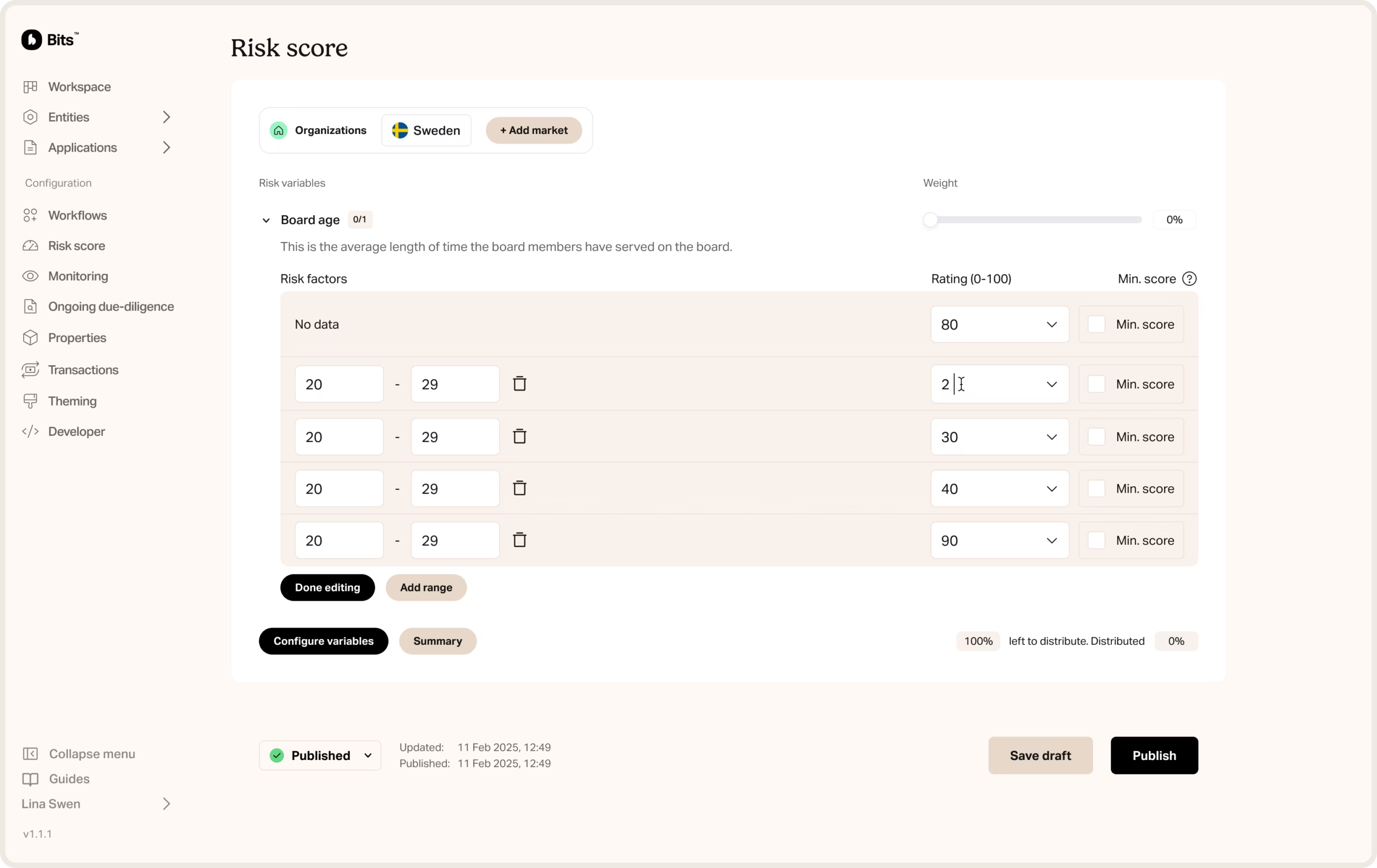
Founded in 2022 and headquartered in Stockholm, Bits offers a pan‑European compliance automation platform that helps businesses streamline onboarding, mitigate risk, and meet regulatory requirements across more than 100 jurisdictions.
The company’s solution focuses on customizable know‑your‑customer (KYC) and know‑your‑business (KYB) workflows, connecting to a wide ecosystem of data sources and electronic‑ID providers to deliver a unified view of company registries, beneficial‑ownership data, politically exposed person (PEP) and sanctions lists, and fraud signals.
By consolidating these different data feeds and automating AML and fraud decisioning, Bits replaces fragmented, market‑specific compliance stacks with a single, scalable platform that supports the entire compliance lifecycle, from initial onboarding to continuous monitoring.
Bits, which serves clients including Qliro, Alisa Bank, and Walley, claims its solution has allowed for dramatic efficiency gains, reducing manual case handling by 50% to 70%, while speeding up onboarding and approval times by four to six times.
In February 2026, Bits raised EUR 12 million in Series A funding. The company said it would use the proceeds to expand product capabilities, increase automation across fraud and financial crime detection workflows, and add further European data coverage. Bits also plans to scale its go-to-market organization as it targets continued expansion across Germany, Austria and Switzerland (DACH) and the UK.
Bits’ rapid adoption, combined with its fresh fundraise, makes it a notable fintech startup to watch in 2026.
Featured image: Edited by Fintech News Nordics, based on image by nihayet69 via Freepik
